Cas clinique

Prise en charge d'un patient CPNPC de stade précoce

L. Bourdenet*
G. Eberst*
*Service de Pneumologie, oncologie thoracique et allergologie respiratoire
CHU de Besançon
Les auteurs ont déclaré ne pas avoir de liens d'intérêts concernant les données publiées dans cet article.
Mis en ligne : 16 septembre 2026 Temps de lecture : 6 mn

Introduction

Ces dernières années, la prise en charge des cancers bronchiques non à petites cellules (CBNPC) de stade précoce a évolué, avec l'émergence de stratégies périopératoires intégrant chimiothérapie, immunothérapie et thérapies ciblées.

Vous recevez en consultation Madame C., 70 ans, OMS 1, tabagique sevrée (4 PA), ayant pour seul antécédent un glaucome, dans un contexte de toux chronique.
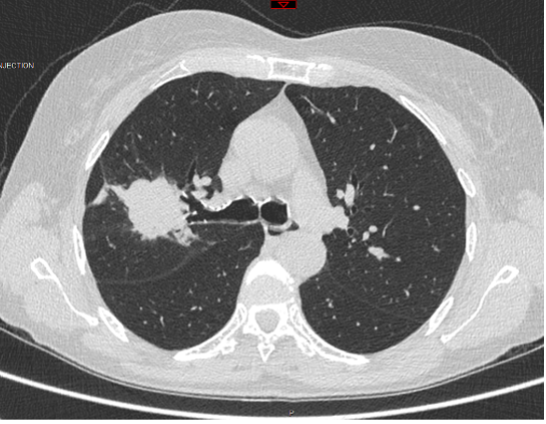
Le scanner thoracique met en évidence une masse spiculée du lobe supérieur droit mesurant 51 x 42 mm (fig. 1).

Figure 1 : Scanner thoracique

Le bilan est complété par :

  • une TEP-TDM objectivant une lésion hypermétabolique du lobe supérieur droit associée à une adénopathie hilaire droite suspecte, sans autre localisation à distance ;
  • une fibroscopie bronchique sans anomalie endobronchique ;
  • une biopsie transpariétale sous scanner permettant le diagnostic d'adénocarcinome pulmonaire, avec expression PD-L1 à 40 % ;
  • une IRM cérébrale normale ;
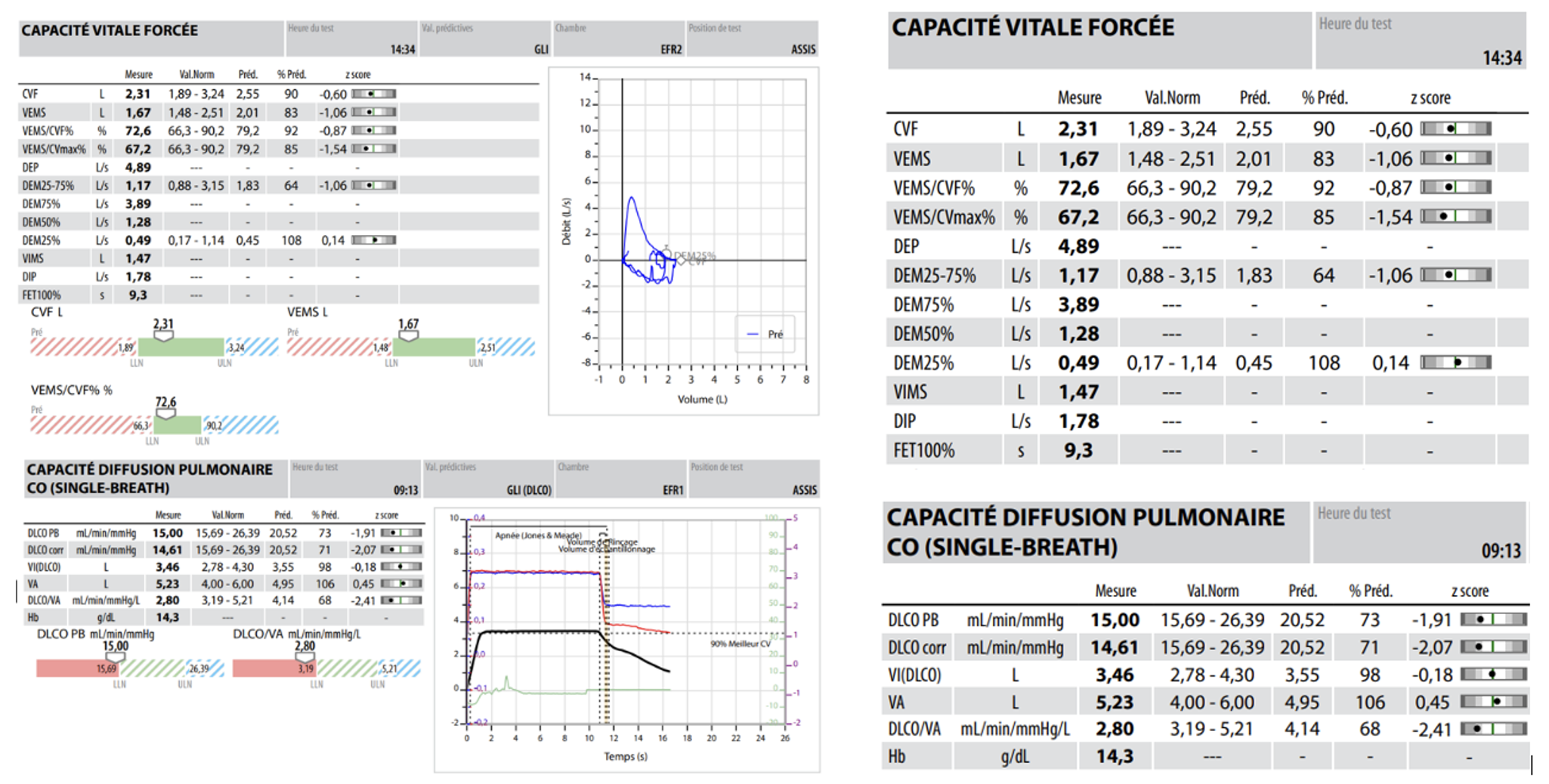
  • des épreuves fonctionnelles respiratoires (EFR) ci-jointes (fig. 2).

Figure 2 : Épreuves fonctionnelles respiratoires (EFR)

Merci de vous connecter ou de vous inscrire pour répondre au cas clinique : Prise en charge d'un patient CPNPC de stade précoce

BIBLIOGRAPHIE

  1. 1. Brunelli et al.

    ERS/ESTS clinical guidelines on fitness for radical therapy in lung cancer patients (surgery and chemo-radiotherapy). Eur Respir J , 2009 Jul;34(1):17-41.

  2. 2. Brunelli et al.

    Physiologic evaluation of the patient with lung cancer being considered for resectional surgery: Diagnosis and management of lung cancer, 3rd ed: American College of Chest Physicians evidence-based clinical practice guidelines. Chest, 2013 May;143(5 Suppl):e166S-e190S.

  3. 3. Recommandations INCa-SPLF.

    Cancer du poumon : bilan initial. INCa, 2011.

  4. 4. Forde et al.

    Overall Survival with Neoadjuvant Nivolumab plus Chemotherapy in Lung Cancer. N Engl J Med , 2025;393:741-752.

  5. 5. Alifano et al.

    Cohorte nationale française EPITHOR. The Lancet , 2023.

  6. 6. Le Pechoux et al.

    Postoperative radiotherapy versus no postoperative radiotherapy in patients with completely resected non-small-cell lung cancer and proven mediastinal N2 involvement (Lung ART, IFCT 0503): an open-label, randomised, phase 3 trial. The Lancet , 2022 :23 :104-114.

  7. 7. Gathers et al.

    Neoadjuvant, perioperative, and adjuvant immunotherapy in early-stage surgically resectable non-small cell lung cancer Cancers 2025 , Jun 21;17(13):2077.

  8. 8. Wu et al.

    Osimertinib in Resected EGFR-Mutated Non-Small-Cell Lung Cancer NEJM, 2020;383:1711-1723.

  9. 9. Mazières et al.

    Immune checkpoint inhibitors for patients with advanced lung cancer and oncogenic driver alterations: results from the IMMUNOTARGET registry. Ann oncol , 2019 Aug 1;30(8):1321-1328.

  10. 10. Pérez-Pérez et al.

    Diagnostic accuracy of the Idylla mutation test for detecting EGFR mutations in non-small cell lung cancer Lung Cancer , 2025 Jul:205:108623.

  11. 11. Solomon et al.

    LIBRETTO-432, ASCO 2026. J Clin Oncol 44, 2026 suppl 17; abstr LBA3.